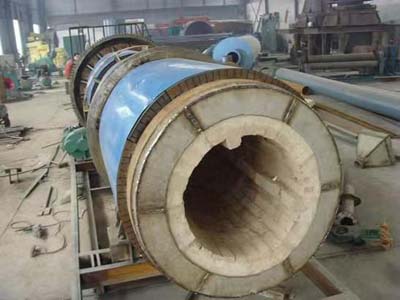
If you prioritize stable product quality, high activity, and large production capacity, a rotary kiln offers significant advantages. However, if your project budget is limited, your footprint is small, and you don’t have high requirements for product activity, a vertical kiln is a more economical choice.
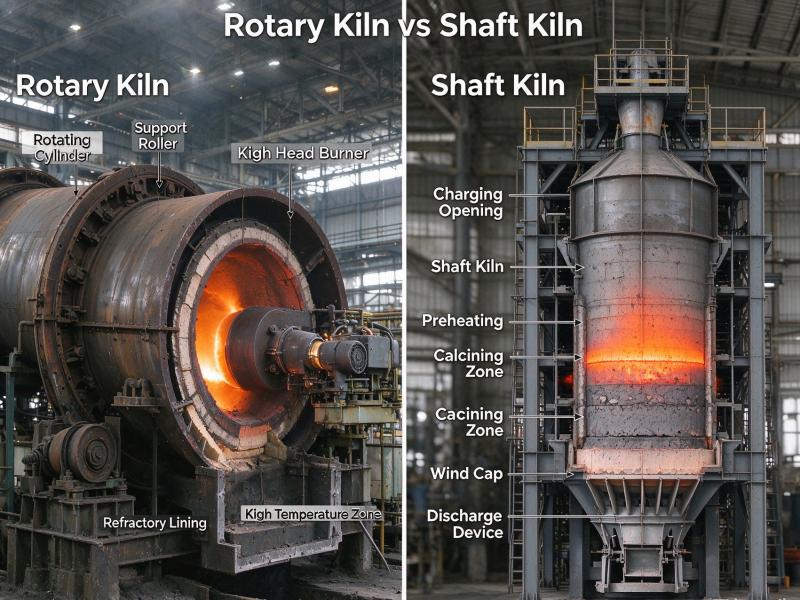
The following comparison focuses on four core dimensions:
1. Product Quality and Uniformity
The rotary kiln’s rotating cylinder tumbles the material, resulting in more uniform heating and lower rates of under-burning and over-burning. For lime calcination, rotary kiln products typically exhibit higher activity, averaging about 30 ml higher than those from vertical kilns, and the impact of fuel ash content on the finished product’s activity is relatively small.
In contrast, traditional vertical kilns, due to the relatively static nature of the material, are prone to inconsistent product quality due to uneven material distribution or temperature fluctuations, with under-burning and over-burning being more common. However, it’s important to note that modern externally combusted vertical kilns, through isolated combustion chambers, can significantly improve product purity and density, even outperforming rotary kilns in the calcination of certain refractory materials.
2. Raw Material Adaptability
Rotary kilns offer greater tolerance for raw material particle size. It can handle small particles or fragile materials of 15-50mm, helping to fully utilize mine tailings and achieving high resource utilization. Vertical kilns, on the other hand, typically have stricter requirements on the particle size of the feed material (traditional kilns often require 40-80mm or even larger) and can often only process large pieces, with poor adaptability to powdery or small-particle raw materials.
3. Capacity and Investment
Capacity Scale: Rotary kilns have a large single-unit capacity, commonly reaching 200-1200 tons per day, suitable for large-scale production needs. Vertical kilns have relatively limited single-unit capacity, with traditional kilns typically ranging from 50-300 tons/day. Although modern large-scale vertical kilns have improved, their overall scale is usually smaller than that of rotary kilns.
Investment and Footprint: Vertical kilns have a relatively simple structure, requiring less investment and space, and have lower processing costs. Rotary kiln systems (including preheaters, coolers, etc.) are large and complex, with high initial investment, and the kiln body can be tens of meters long, requiring a large area.
4. Energy Consumption and Environmental Protection
In terms of energy consumption, vertical shaft kilns generally have certain advantages. Their unit product standard coal consumption may be lower (some vertical shaft kilns have data of 120-145 kg/t, better than some rotary kilns ≥180 kg/t), and the exhaust gas temperature is lower with less dust content, making purification easier. Although rotary kilns have reduced some energy consumption through new processes, their overall heat and electricity consumption (power of the air supply system) remains higher, and the long cylinder results in greater heat loss.
In short, if you are producing highly reactive lime or processing small-particle raw materials and have sufficient funds, a rotary kiln is a safe choice. If you have limited funds, space, and the raw material particle size is larger and the reactivity requirements are not stringent, you can prioritize modern vertical shaft kilns (such as double-chamber kilns or externally combusted vertical kilns) to reduce investment and operating costs.